
The Monastic Life and the surrounding area of the Holy Monastery of Pantokrator
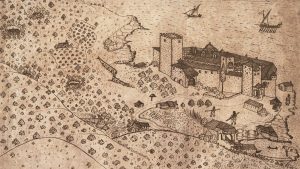
For more than a thousand years, Mount Athos has been the main spiritual home of the Orthodox Church. On Mount Athos, the monastic consciousness has preserved unchanged a way of life with residences, crops and a traditional rural architecture that is particularly valuable and rare. The organized living together of people from the 10th century onwards, created buildings such as the Catholics and the precinct, the bank, the cells, the hospital, the library, chapels, fortified towers, harbours, Sketes, Cells, Seats, etc., which are the model of orthodox monastic cathedrals in modern society.
The areas that make up the monastic complexes, and that of the Holy Monastery of Pantokrator, are the Cookhouse, the Bank, the Bakery, the Bakery, the Crasario, the Ladario, the Vourdounario, the Hospital, the Pharmacy, the Carpenter’s Shop, the Blacksmith’s Shop, the Oil Mill, the Shoemaker’s Shop, the Arsenal, the Worker’s House, the Farmhouse and the Forest House, the Warehouses, the Monks’ Cells.
Ioannis Komnenos notes in his Pilgrimage in 1701 that “the holy and venerable monastery of Pantokrator is very beautiful, because it is located in a good location close to the sea, surrounded by a solid castle”.
The buildings surrounding the monastery of Pantokratoros, combined with the general morphology of the terrain, create a particularly picturesque settlement.
Each of these places had its own contribution and its own means and tools to effectively serve the purpose for which it functioned.
In this space too, the life of the monks adapted to it, evolved with it and was interconnected with the monastery.
The refectory that exists in every monastery is not only the place for the fulfillment of the need for food, but is a basic link in the monastic life. Through the ritual it follows, it functions as a natural continuation of the liturgical, spiritual and experiential monastic life.
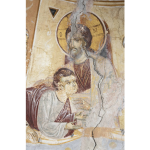
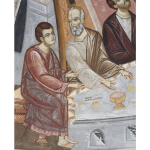
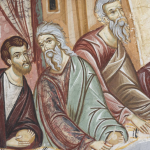
Jesus himself at the Last Supper, blessed the Bread and Wine, and converted them into his Body and Blood, and this formed the basis on which the common Christian meals leading up to the altar were founded.
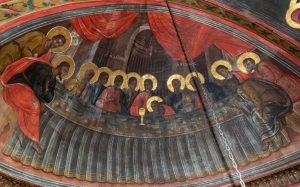
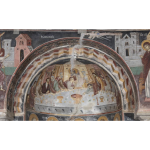
In the iconographic decoration of Athonite tables it is customary to include representations inspired by the gospel narratives related to food and meals. Almost invariably, behind the ecumenical table is the Last Supper, with clear Eucharistic symbolism.
Also a related performance is the Hospitality of Abraham, where the Old Testament pair of righteous men host three angels, who are the early appearance of the Holy Trinity. The details on the table in these scenes are interesting, with a variety of serving utensils, cutlery, and foods such as round breads and bulbous roots, which also reflect the daily diet of the monks.
Christ, throughout his presence on earth, used to dine in the homes of disciples and other people.
Ιω. 12,2 : They made him a supper there, and Martha dined with him, and Lazarus with those that were with him.
In particular, the Dining Room of Pantokrator Monastery, which is located on the first floor of the west wing, directly opposite the Catholicos, has a rectangular shape with a niche and wooden benches. It is located south of the Tower and in functional unity with the Canteen. It was moved to this location from the ground floor of the same wing, now used as the Dome. It was renovated in 1744, by a donation from ¨Mr. Reverend Mr. Triantafyllou and the new founder¨. In 1749 the altar was hagiographed by the hagiographers and Hieromonk Seraphim, Kosmas and Ioannikio from Giannia, at the expense of the Monk Timotheos from Lemnos.
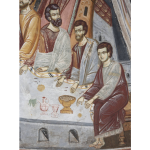
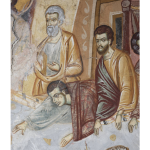
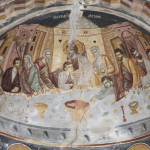
The Pantokrator Monastery’s Canteen is located in the west wing of the monastery, opposite the Catholic Church and next to the refectory.
The monks on Mount Athos, apart from prayer, are also called upon to contribute to the monastic community to which they belong. Thus, each one takes on a task,
or, in monastic terminology, a vocation. One of the most basic ministries on Mount Athos is that of cook. Early on, the cook must prepare the food so that when the holy service is over, the Fathers will find the meal ready. The food is proportional to the day. After each meal the altar should be cleaned and ready for the next time. This ornament is performed by the Trapezar, the monk in charge, with his assistants, the paratrapezarians. The fathers, always with a blessing on their lips:
“Lord Jesus Christ, have mercy on me,” they pick up, sweep, wash and clean the floor. At the clean altar the tables are re-laid so that everything is ready for the next time. The same monks make sure that the food is placed on time and served. For this reason they always leave before the services in the Catholic Church are over, go to the table and complete the serving so that everything is ready and warm when the monks and pilgrims enter.
During the Table, one of the fathers of the monastery takes over to read the reading. Either by going up to the special pulpit, or from the special lectern called a tablet placed in the middle of the table, he reads clearly and aloud the reading chosen for the day. It may contain lives of saints, interpretations and discourses of fathers related to the feast or the Gospel reading for the day.
The Ladarium of the Holy Monastery of Pantokrator is located in the west wing, opposite the Catholicos and under the altar.
The Furnace of Holy Monastery of Pantokrator is located next to the tower of the Monastery.
The Crasarium of Holy Monastery of Pantokrator is located in the west wing, in the old monastery complex of the 14th century. Old barrels and the system of wooden channels that connected the wine press with them are preserved.
The arsana includes a set of buildings that used to serve on a daily basis the main transit needs and the protection of small ships.
The laver ‘s house of the monastery of Pantokrator is a 19th century building. It is now used as a workhouse and warehouse.
The two aqueducts of Holy Monastery of Pantokrator with the characteristic arched pillars date from the 14th century and the one west of the monastery from 1780.
The gazebos of Holy Monastery of Pantokrator with the first one attributed by design to Barsky – 18th century -. The one with the well is located west of the monastery, at the end of the path from Karyes and next to the aqueduct and was the resting place of the pilgrims and a place to prepare their entrance to the monastery.