
Soil morphology - environmental and climatic conditions in The Holy Monastery of Pantokrator
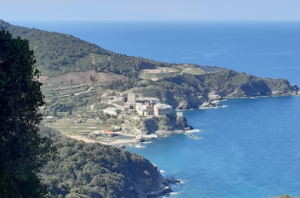
The vegetation of Mount Athos has a special, rich and peculiar character based on its location, the morphology of the terrain and the Mediterranean climate.
In terms of flora, the Athonite state is characterised by a high density of vegetation which, together with the impermeable rocks, prevents the flow of water and prevents it from being lost in the depths of the soil. Forests and shrubs are abundant, while certain species are found exclusively in the area and the area is described as a botanical paradise.
Experts, who have studied the flora and fauna, have concluded that this abundance is mainly due to the location and geology of the peninsula. In particular, the fact that it extends deep into the sea, the high altitude (2,033 metres), the climate, the mountainous soils, the abundance of rocks, the geographical isolation and the absence of herds are particularly favourable to the vegetation of the area. The terrain includes almost all the vegetation zones found in Greece.
On the peninsula of Mount Athos, the vegetation shows a peculiar evolution and a clear vertical structure in zones. The position of the Mount at the end of a long and narrow peninsula in the sea makes it possible for Mediterranean vegetation to fully develop and evolve at its lowest level.
According to Babalonas (“Plants of Mount Athos”, 1997), the main vegetation units on Mount Athos, where the vegetation cover exceeds 95%, are:
1) The formation of sclerophyllous / evergreen vegetation that forms at low altitudes a first vegetation zone. Depending on local soil, climatic and other differences, this vegetation has different structures representing different Mediterranean plant communities in the area. The structure of this Mediterranean vegetation is best and most representative in the east-northeastern coastal zone, the location where the farm is built on a rocky outcrop at the end of a wooded slope, at a height of about 30 metres from the sea.
2) In the mountainous zone and at altitudes higher than 500 meters, where the predominance of deciduous woody species is clear. There, chestnut forests dominate in area, followed by oak and beech forests.
3) Particularly on Athos and at an altitude of 600 – 1 550 m, there are pure or mixed fir forests and black pine forests in places, while in the subalpine zone and after the forest boundaries, where soil conditions allow, herbaceous grassland vegetation predominates.
There is also a strong crop activity in the area. Some of them are the cultivation of vineyards, the cultivation of medicinal plants, the cultivation of orchards, olive groves and vegetable gardens, crops that are attested from Byzantine times and include items necessary for the cult and for the daily diet of the monks (wheat, olive oil -not only for food and candles today, but in the past also for lighting the lamps-, wine, vegetables, fruits).
In the Holy Monastery of Pantokrator, the care and cultivation of all these is one of the ministries of the monks.
As for the sea, especially in earlier times, it supplied the monastery with its catch.