
Kollyva
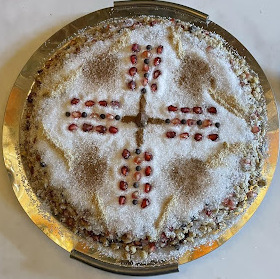
In collies, wheat is associated with strong symbolism. When the body is put into the earth and buried, and it appears to be now melted, it is born. The soul blossoms and the new spiritual body, in the day of judgment – at the Second Coming, will be like the wheat which yields a hundredfold.
In the twelfth chapter of St. John’s holy Gospel it is said, “the grain of wheat, if it does not die when it falls to the ground, remains alone (and does not multiply), but if it dies, it bears much fruit.”
And Paul, in 1 Corinthians 1, states: “that which thou sowest is not quickened, except it die first,” and this, because the dead body is buried in the earth and rots, just as it is with the grain of wheat.
Colloquies are prepared on Pentecostal Sabbaths-the Sabbath before Apocalypse Sunday on Pentecost as on the first Sabbath before Pentecost Sunday-as well as in the celebration of a memorial prayer for the repose of the departed.
In the monasteries, they make collies in memory of the founder of the monastery, they are also offered in memory of a saint – on his or her feast day – and they are also a daily sweet. According to tradition, it was St Theodore of Tiron who introduced the collies.
Kollyva symbolism
Ingredients
| For the mixture: | |
| 1 kg of wheat, hulled or unhulled, of any quality | |
| ½ kilo of breadcrumbs well grated | |
| ½ kg of coarsely ground walnut flour, preferably roasted | |
| ¼ kg of coarsely ground almond meal, preferably blanched and roasted | |
| ¼ kg finely ground hazelnuts, preferably roasted | |
| ¼ of a kilo of grated coconut | |
| 1 wine cup of mixed black and white raisins, preferably seedless | |
| 1 wine cup of toasted and ground sesame seeds | |
| 2 tablespoons of cinnamon (optional) | |
| ½ tablespoon of cloves | |
| ½ wine cup of orange or lemon zest | |
| 1 teaspoon of pomegranate seeds | |
| For the decoration: | |
| proportional to the quantity we want, deep or shallow tray | |
| various paper or synthetic drawings of our choice (optional) | |
| ½ kilo of icing sugar or icing sugar (depending on the surface to be used for the design) | |
| cinnamon for the dichroism in the design | |
| depending on the design we want and our preference in materials, we calculate the quantity of: almond nuts, preferably white or not and preferably split in half, whole walnut crumbs, preferably in half, hazelnuts, preferably white or not, silver or chocolate candies of various designs, sweet or sour pomegranate fruit and various other nuts of our preference (such as raisins, dried fruit, etc. ) and combinations of various suitable materials (e.g. coloured sugar, etc.) |
- Tip:
- Collies are used in the Orthodox Church for the commemoration of the deceased, such as psychosabbaths, forty days, nine days, three days, annuals, etc. The same are used for the memorials of the celebrated saints, with the reading of a special blessing for each occasion.
- In different regions they have local traditions in terms of construction and use, giving some interpretations-symbolisms for each material, quantity, designs, colours, etc.
- The mixture you have completed, but without the pomegranate, can be divided and packed in bags to store in the freezer for later use. This way it will keep for months.
- Careful, never add sugar to the mixture to avoid excess sweetness and slushing. The sugar added to the top is enough for a pleasant sweet effect.
- After the reading of the blessings by the priest, they are distributed to the people after mixing them well to sweeten them with sugar.
- They are consumed on the same day, at all hours of the day, without the need for any fasting or spiritual preparation.
- We never throw away the glosses in the garbage, as long as they have been read in the Church.
- In case they spoil (sour), we throw them in a clean place to be eaten by birds or in the sea or in a river, so that they are not stepped on by humans.
Execution
| 1. | Wash the wheat from the day before and soak it in lukewarm water with a little salt in a suitable bowl or pot. |
| 2. | ΤThe next day we rinse it to remove the blackness and boil it in new water for at least half an hour. |
| 3. | During the boiling process, interrupt the boiling by pouring cold water from time to time to make it easier to open. |
| 4. | Care must be taken not to melt it but also not to leave it uncooked. |
| 5. | When it starts to open and has boiled well, strain it in a colander and keep the porridge in a bowl for other uses (such as a drink, soups, creams, etc.). |
| 6. | Ξwash the wheat very well with cold water -a lot of water- and leave it to dry for 2 hours in a colander. |
| 7. | Spread it on a clean large towel or on special absorbent paper and cover it accordingly so that the water is absorbed and it dries well, not dry. |
| 8. | Then, in a similar bowl, pour the dried wheat and all the ingredients of the mixture. |
| 9. | Mix well so that the mixture becomes uniform. Be careful not to add sugar to the mixture. |
| 10. | In a suitable tray, pour all the mixture and spread it out so that it forms a smooth, not pointed, mound. Press it down hard and in circles with your hands, so that it becomes uniform and smooth and smooth to make the decoration. |
| 11. | Once the cake is well stained and free of lumps, start decorating. |
| 12. | With a spoon, carefully pour the sugar, sprinkling the surface of the mixture starting from the edges of the tray towards the centre. Make sure that the entire surface is covered without gaps or lumps and that you have enough to cover the entire surface. If you have chosen a large surface area then you will need more sugar. |
| 13. | Once complete, place the ornaments creating a cross in the centre with the nuts and designs around the perimeter of the tray. |
| 14. | If you have designs on paper, place the paper in the centre of the tray (instead of the wrists), so that it touches the sugar well. Pour the cinnamon into the gaps in the design and carefully remove the paper to keep the design intact. |
| 15. | We complete the decoration of our choice, clean the tray peripherally from any crumbs, check for perfection, and the decorations are now ready for the church to bless. |